Today we’re talking about juxtaposition, and how to use it as a writing tool. Let’s start with a definition.
juxtapose
verb
To place side by side for the purpose of comparing or contrasting.
I am fascinated by how the juxtaposition of objects, creatures, or ideas changes our perception of them. Consider, for example, how things change when we see one abandoned can versus a collection of them.

Or what happens when the color purple is surrounded by green versus purple surrounded by pink.
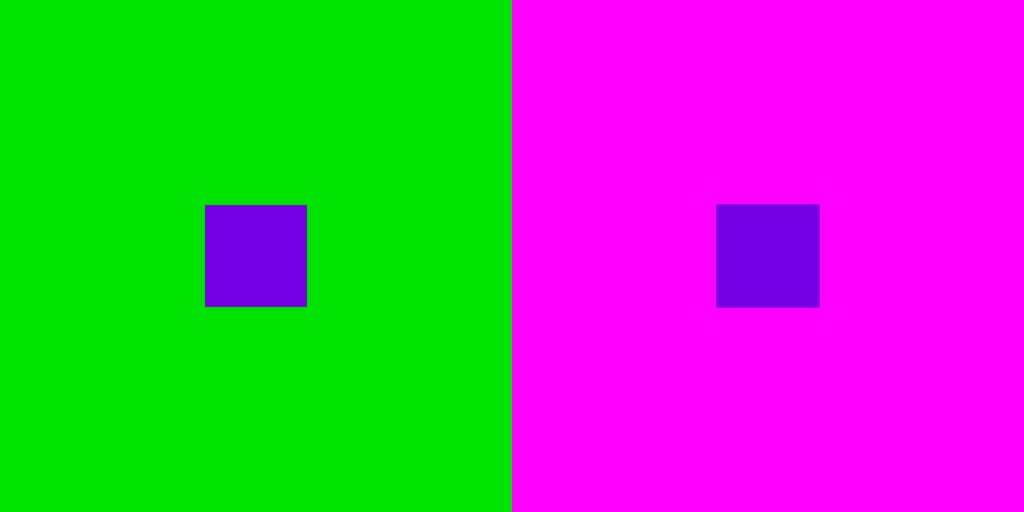
Objects together are different than on their own. It’s the magic of juxtaposition.
Juxtaposition + Writing
How can the concept of juxtaposition help with your writing?
You’ve probably seen and done writing exercises that are one word prompts (car, party, etc.). These are simple and effective. But, given the magic of juxtaposition and the fact that our brains are wired to make connections, let’s try an exercise with two items. Ready? Let’s play.
SUPPLY LIST
- Your notebook. I usually use three pages for this, the first two divided into four sections each and the third one blank.
- A writing instrument.
- Two items to compare. Literally anything goes here. Really. You can use anything you can think of. Abstract ideas, animals, activities, physical or digital things, etc. You do not need to have physical items.
Your two items can be in the same general realm, like baseball and gymnastics or peaches and apples.
Or distinct, like a mug and Barbie or a chair and an elm tree.
They can be totally different, like a rock and the Theory of Relativity or Game of Thrones and an app.
They can be two types of the same thing, like two different books or two bands.
They can be debated topics, like ebooks versus physical books or pizza with pineapple versus pizza without pineapple.
Any two items will work.
For this example, we’re going to use rabbit and water bottle. You’ve got your notebook handy, no? Then let’s move on to the steps of the exercise itself.
THE STEPS
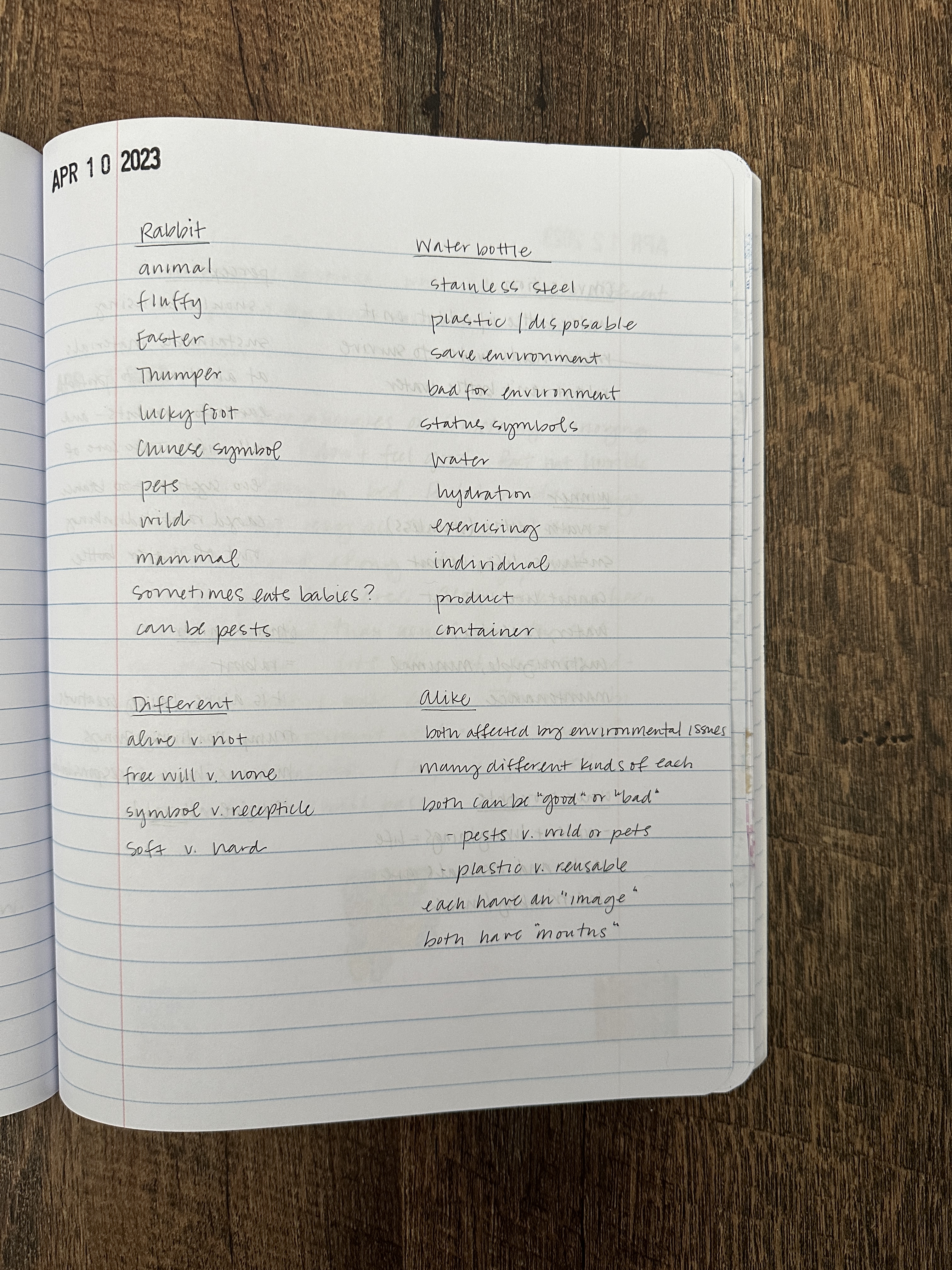
1. Write 5-10 things about each individual item.
It’s a good idea to spend some time with each of the items individually before considering them together. Make a quick list of the general attributes of each item and anything it makes you think of. Note that you could pick a specific rabbit and water bottle, you could consider the categories of rabbits and water bottles as a whole, or you could do both.
2. Juxtapose the items, and respond to six questions.
Now let’s consider the items together. Mentally (or physically if you want) place the two items side by side.
From here, let’s answer a few questions in pairs, shooting for 3-5 responses to each one. First, these two:
How are the two items different?
How are the two items alike?
This can feel a little silly, but push yourself to find 3-5 differences and 3-5 similarities. Compare color, shape, material, biology, texture, function, etc.
Next, these two questions:
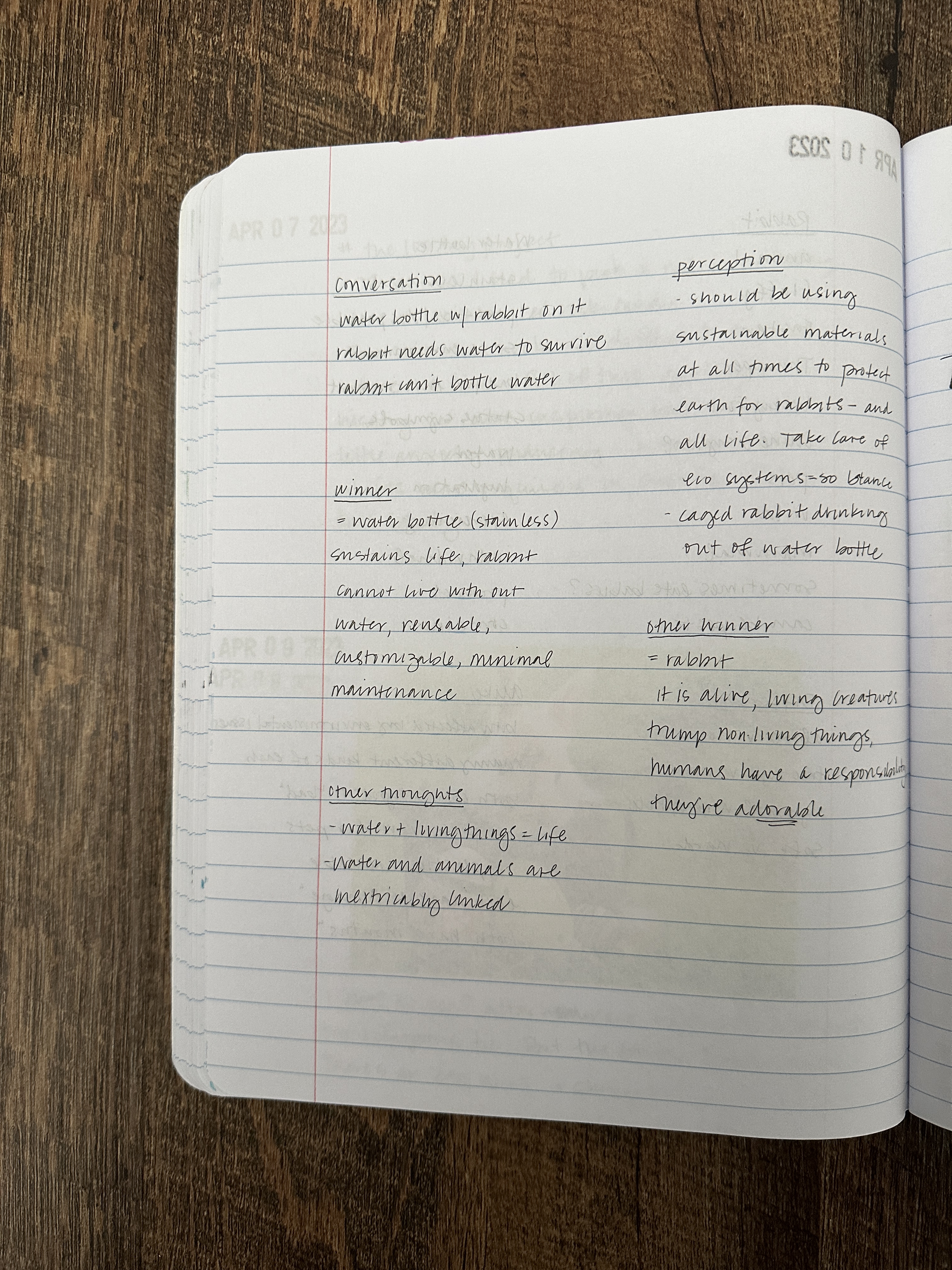
How are the two items in conversation with each other?
Do the two items together change your perception of either individual?
While these two questions are similar, they can result in very different responses. For the first question, I focus on the words. I put the two items in conversation with each other by considering the words together: “rabbit water bottle.” What does that make me think of? Then I switch the order: “water bottle rabbit.” How does that change things? I write down anything that comes to mind, trying not to edit my thoughts.
For the second question, I focus on the visuals, seeing if, like the color example above, my perception changes when the two items are physically next to each other. I visualize the rabbit next to the water bottle. Write down my impressions. Then I consider the water bottle next to the rabbit.
And, finally, these two questions.
If you had to pick one item to “win,” which would it be and why?
If you had to pick the other item to “win,” what would be the basis?
This is an excellent mental exercise, forcing you to choose criteria with which to judge one item against another, and then forcing you to argue the other way. Any criteria goes. One is bigger, smaller, or cuter. One is more complex, simple, or elegant. One is more alive, important, or fun. Or, you just plain like it better. Whichever item you select to win, the important thing is the reasoning behind it.
Here is a look at my responses to Steps 1 and 2:
3. Pick something to write a page about.
Look over the things you have written and circle 1-3 ideas that sparked during the first two steps. Then write about one or more of those sparks.
I find that this juxtaposition exercise stretches the mental muscles in a satisfying way, bringing in description and persuasion and critical thinking and often resulting in interesting insights.
If you try out this exercise, please share your experience in the comments. Thanks for playing today.
 Textual Play