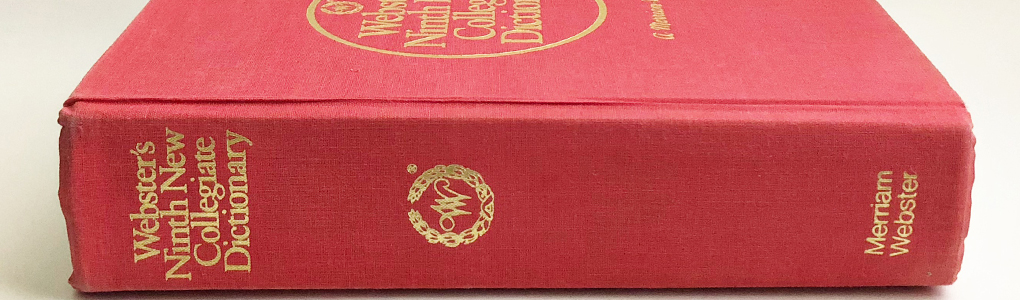
I bought the dictionary above with my own money just after I turned eight. Since then, this dictionary has been a steady companion, attending me throughout elementary school, junior high, high school, college, and beyond. It is worn, true, and lacks words like “doh” and “twerk,” but it is useful still.
Today, this trusty tome and I are going to introduce our first game here on Textual Play. Dictionary Dive is simple but meaningful. It has four steps.
- Identify, either purposefully or at random, a passage in a text.
- Select a word from that passage that catches your attention.
- Look up the word in the dictionary.
- Examine whether the definition sheds further light on the passage or on the work as a whole.
We begin, as always, with our text. Today, I’m using Harry Potter and the Chamber of Secrets. I opened the book at random to near the end of Chapter 14. Hermione has just been petrified, and Professor McGonagall addresses the Gryffindors:
I need hardly add that I have rarely been so distressed. It is likely that the school will be closed unless the culprit behind the attacks is caught. I would urge anyone who thinks they might know anything about them to come forward.
Next, we identify a word and dive into the dictionary. The word that jumps out at me is “culprit”:
1: one accused of or charged with a crime
2: one guilty of a crime or a fault
How does this definition bring greater meaning to the text?
The thing that strikes me is that there are at least six culprits under those definitions in this situation.
Harry is a culprit who has been accused of, but has not actually committed, a crime. Harry has suffered under the false accusations of Mr. Filch and his classmates for months. We know Dumbledore does not accuse Harry, but that is small comfort given our next culprit.
Hagrid is a culprit who has been accused of opening the chamber of secrets twice. Hagrid has suffered under false accusations for fifty years! His wand was officially taken away; he was expelled from Hogwarts as a boy; and now he is facing Azkaban for something he did not do. Dumbledore (and even Fudge) has expressed his confidence in Hagrid’s innocence, but Hagrid was still expelled and is still sent to Azkaban.
Lucius Malfoy is a culprit who has set the crimes in motion. It was he who placed Tom Riddle’s diary in Ginny’s cauldron. It was he who caused Ginny, a young, innocent girl of only eleven, to be possessed by evil and to wreak havoc on her school. While he did not actually commit any crime, he is culpable for the crimes committed by Ginny.
Ginny is a culprit who has actually physically committed crimes, including opening the chamber of secrets multiple times and killing chickens to write with their blood, but she is not guilty of those crimes, since she is not acting of her own free will. She has been overcome by evil and does not know what she has done. She is an innocent in almost every way.
The basilisk is the physical culprit here and is certainly guilty of the crimes of attempted murder and actual petrification. It is a monster, apparently waiting within the walls of Hogwarts for thousands of years just to kill students without pure magical blood. Its eyes are literally the thing that causes the petrification (or death) to occur, but it, too, is an instrument in the hands of another.
Voldemort/Tom Riddle is the real culprit in that he is the one actually orchestrating and intending to commit the crimes. He has instrumentalized not only Ginny, Lucius, and the basilisk but also Hagrid and Harry. His false accusation of Hagrid fifty years ago has had repercussions that have reverberated for the last fifty years. And his possession of Ginny is such an evil act. Viewing the events of this book through her eyes is rather horrific.
Wow. Looking at this book through the lens of the definition of “culprit” was more enlightening than I thought it could be. There is definitely a term paper in here somewhere.
What do you think about the culprits in this text? What other culprits are there? In looking at the second part of the second definition, who is guilty of a fault in this book? Who should have been looking out for Ginny, in particular?
 Textual Play