I really mean this. Take complete ownership of your notebook.
Those bullet journals online are beautiful and lovely, and I want to bullet journal sometimes. But I know from experimentation that it doesn’t work for me right now. I don’t want to spend that much time on the aesthetics.
I used to love the structure of planners like those from Franklin Covey and Day Designer. But those don’t work for me right now either. My digital calendar and task manager handle the day-to-day life stuff.
My notebook handles the ideas and freeform thinking and planning. Right now me needs my notebook to have less structure and less pressure. It is a place to just be and write and create.
Choose a notebook because it works for you, not because someone (or apparently everyone) else is using it.
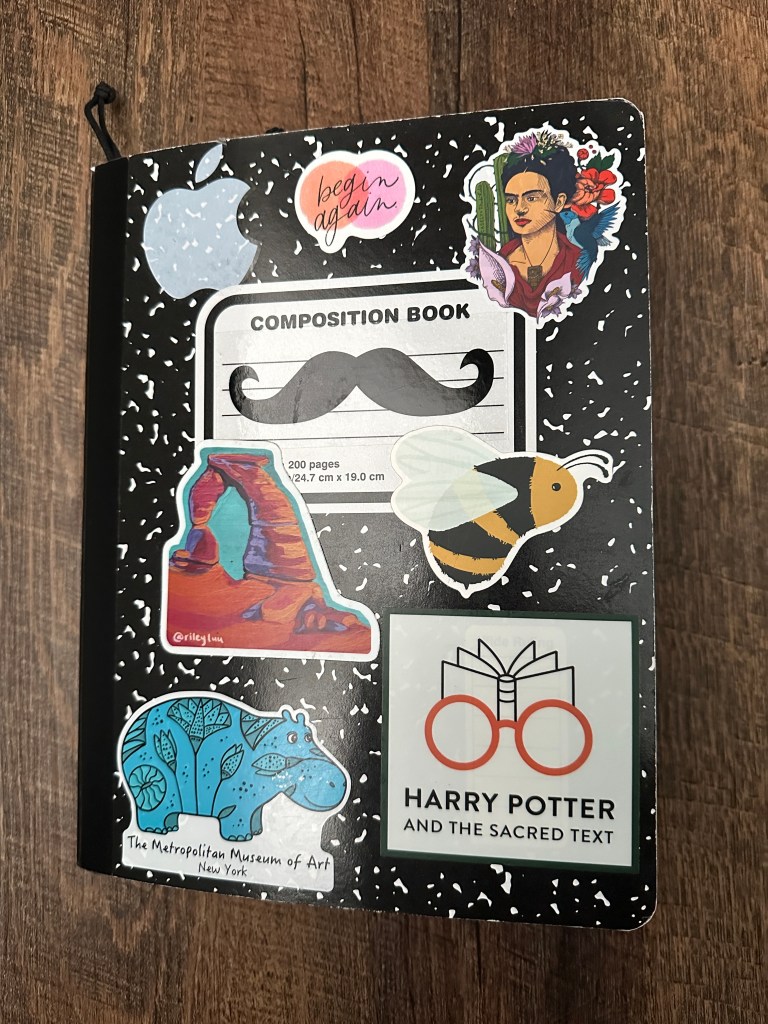
Decorate your notebook, so it makes you happy when you see it.
Put things in your notebook for you – current you and future you but not past you.
Exercise
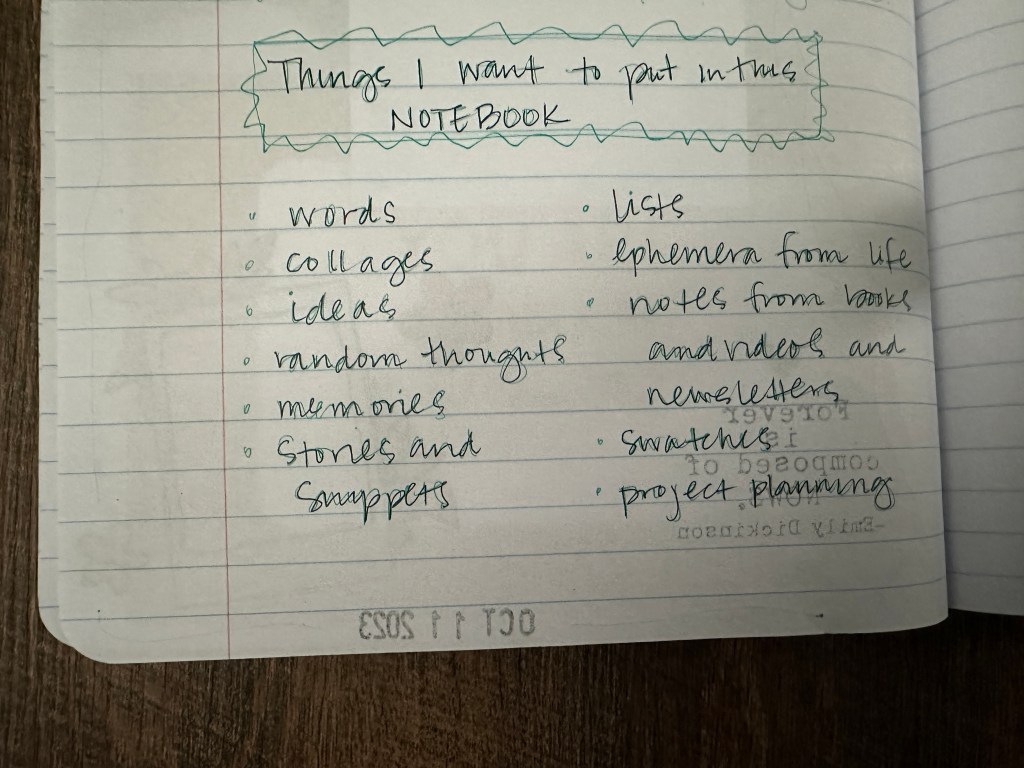
In your notebook, make a list of things you want to put in it. Take 2-3 minutes and write down everything that comes to mind.
Give yourself permission. Start a new notebook, decorate your cover, or begin a new page with something from your list. Take it and make it yours.
I just finished listening to Keep the Memories, Lose the Stuff, by Matt Paxton. I had not heard of Paxton before, but I tend to read a lot of decluttering/minimalism books. This one approached things a little differently, acknowledging the emotions attached to stuff.
Paxton is an expert in helping people downsize and declutter their stuff. One of his key ideas is a legacy list, which he defines as 5-6 must-have keepsakes. This concept helps people to select only those inherited items that mean the most to them. I love the idea of curating items from my grandparents and parents that have meaning, and I will definitely be working on my legacy list.
But Paxton emphasizes that the stories behind the physical items are even more important than the items themselves. Which brings us to notebooks, of course. I feel called to write down my stories.
“If you would not be forgotten as soon as you are dead, either write something worth reading or do things worth writing.” – Benjamin Franklin
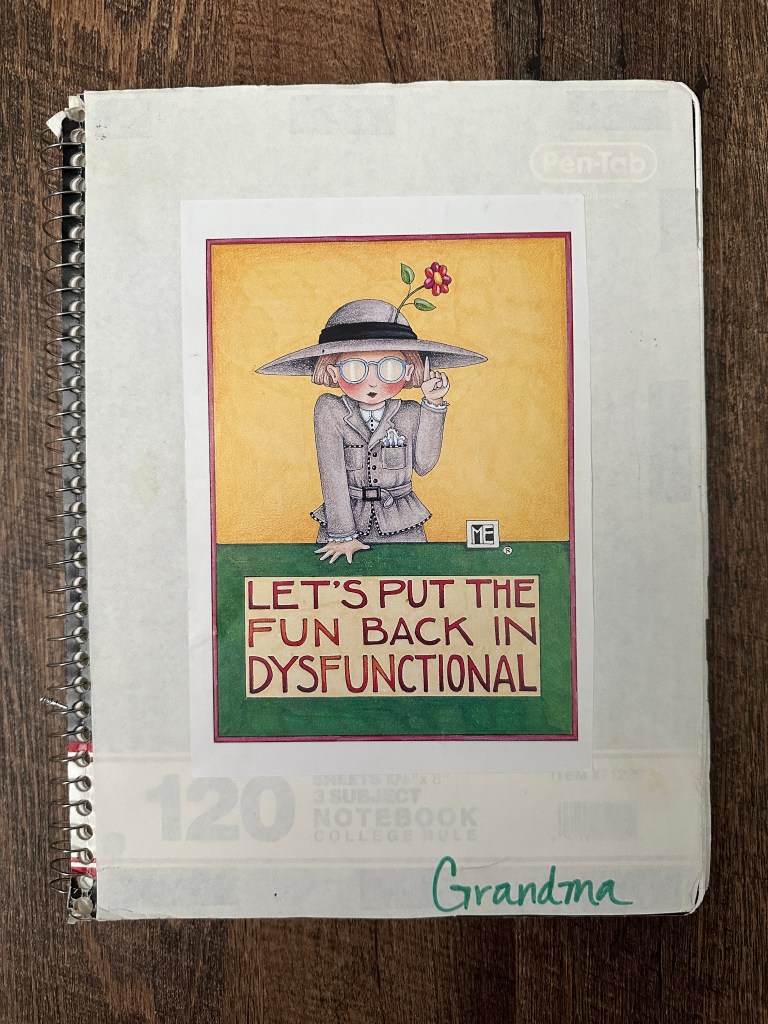
As a young teenager, I was faced with the problem of what to get my grandparents for Christmas. I had a budget of near-zero, which required some creativity. Eventually, I landed on making a memory book. I created a list of questions I wanted to know about them, purchased some spiral notebooks, decorated the covers, taped a baggie with the questions cut into strips into the notebook, and wrapped them up. That was about 25 years ago. My dad’s parents both eventually completed their books and gave them back to me as gifts. They have both since passed away, and those books are treasures, not just to me but to the whole family. It is the only place I know of where any of their stories are written down.
I have written a daily journal off and on for most of my life. I compile photo albums religiously. But I don’t always take the time to write down the stories. I am going to make an effort to write down my stories, starting with this list I created for my grandparents:
List the important dates in your life.
What fun things did your family do together?
Write down make-believe games you played when you were young.
Describe your best friend in grade school.
Describe your grade school years.
Who was your favorite teacher and why?
What special activities were you involved in in school?
What was the best part of high school?
Tell about the fashions when you were growing up.
Describe the first time you drove, your first car, and when you got your license.
When you were a little girl, what did you want to be when you grew up?
What was your first job? How did you get it, and what did it pay?
Describe your wedding day in detail.
Write about your first child – the pregnancy, the preparation, and the arrival.
Describe each of your children’s personalities and funny quirks.
List and describe hobbies you’ve had throughout your life.
List some special awards and recognition that you’ve received.
What is your favorite food and what exotic foods have you tried?
List the top ten influential people in your life.
Describe everything you remember about your mom.
Describe everything you remember about your dad.
Describe everything you can remember about your grandmas.
Describe everything you can remember about your grandpas.
creative notebook noun A place to hold your ideas.
Let’s break it down.
First, it’s a place, a holder, a container. It is typically a notebook of some kind. A place to put thoughts and ideas and doodles and whatever else comes up in your life. But it doesn’t have to be one specific physical notebook. Think of the term “creative notebook” as a concept rather than a specific form and make it work for you.
It could be physical. It could be digital.
It could be big. It could be small.
It could be expensive. It could be a few pages of computer paper stapled together.
It could be one notebook. It could be several notebooks.
The physical reality of it is less important than its use.
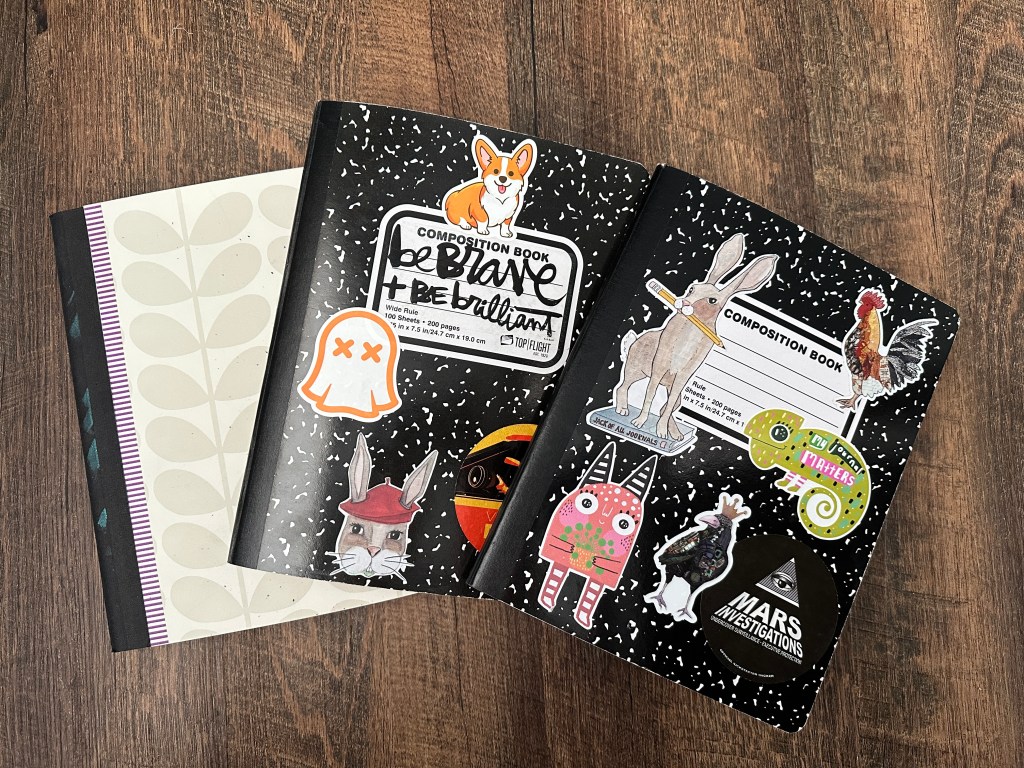
I use one composition notebook at a time. Use whatever works for you.
Three of my recent creative notebooks
Second, it’s for your ideas, your creativity, your life. Creativity can be an intimidating, nebulous word. But again, think of it in broad terms. The “creative” in “creative notebook,” means, to me, the raw materials of life. Your ideas and notes, whatever the context.
It could be for a typically creative endeavor like painting or writing. It could be for your work as a lawyer or project manager or content creator. It could be both. It could be neither.
It could have nothing but words. It could have nothing but images. It could have both.
My creative notebook includes a little bit of everything:
charts
ideas
drafts
research
notes from classes
work notes
free writing about stuff on my mind
swatches
collages
lists
quotes
writing exercises
poetry
brain dumps
diary-like entries
goals
lettering practice
doodles
ephemera from life
any other kind of note or idea I have.
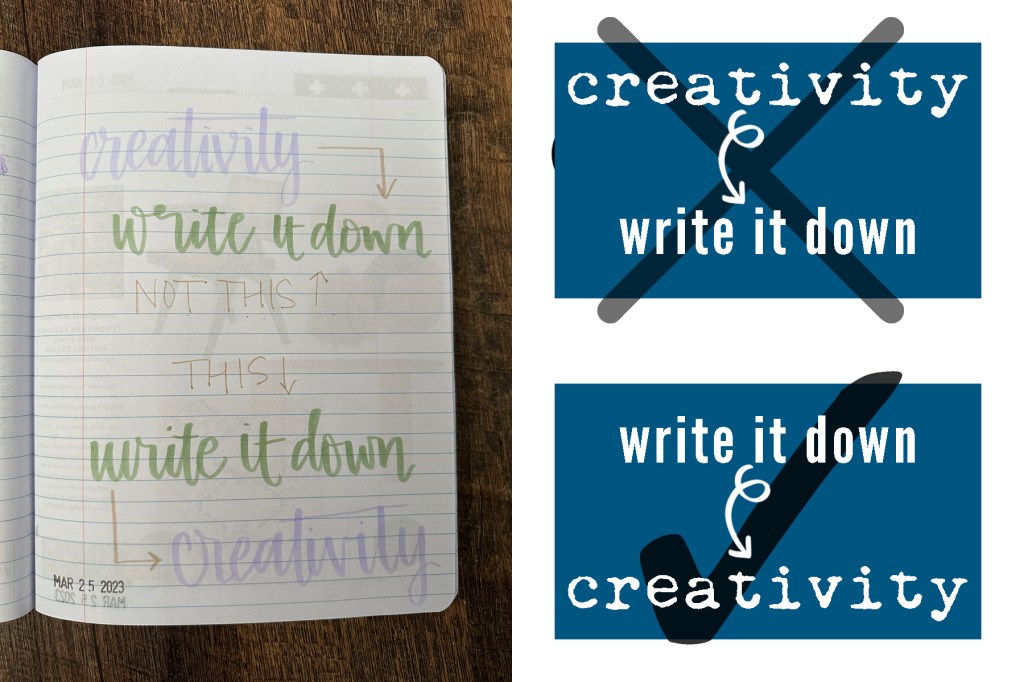
It is not your job to find the creativity and then write it down. It is your job to write it down, and the creativity will emerge.
Practice
Artists call their notebooks sketch books. Writers call them writer’s notebooks or commonplace books. It doesn’t matter what you call it; it matters that you do it.
I recommend starting with putting everything in a designated notebook for a while and see what happens.
The lovely thing about a creative notebook is, if you keep it around and put things into it, the creativity will appear. The mishmash of notes and ideas coalesce, and the whole becomes greater than the sum of its parts. When you see your thoughts and swatches and collages and doodles and lists and whatnot juxtaposed with the others, new connections are made, themes emerge, creativity is found.
 Textual Play